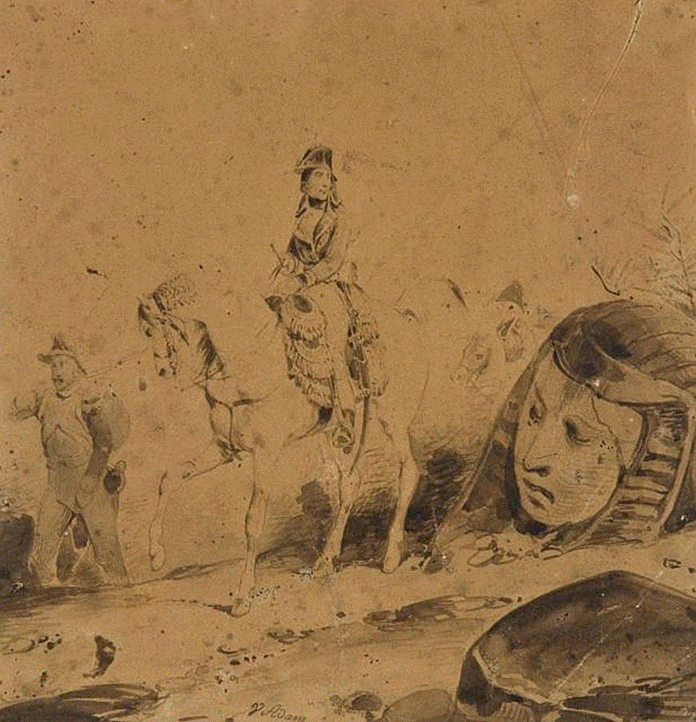
Adam, Victor-Jean (1801-1886), ‘Napoléon devant un sphinx’, (Napoleon before the Sphinx), pen and brown ink over black pencil, 20 x 19 cm.
Adam, Victor-Jean (1801-1886), ‘Napoléon devant un sphinx’, (Napoleon before the Sphinx), pen and brown ink over black pencil, 20 x 19 cm.
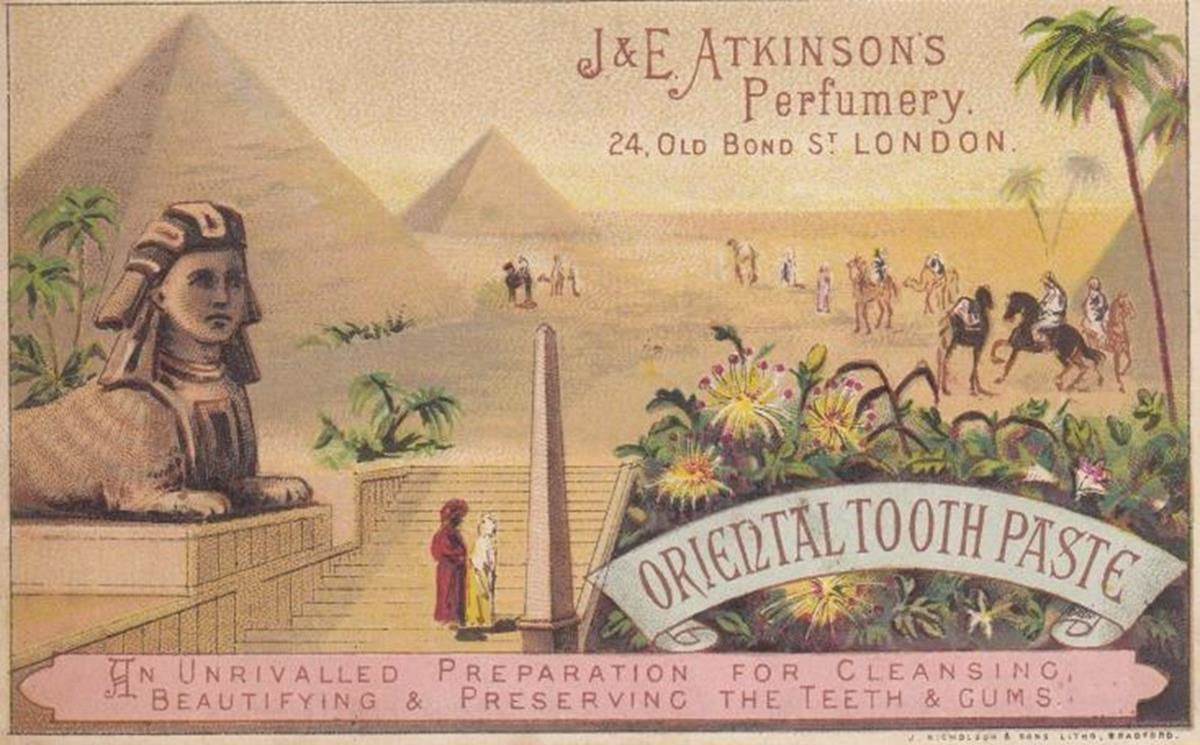
Nicholson, J., and sons (Bradford), ‘Oriental tooth Paste’ for J&E Atkinson’s Perfumery (London), ca. 1882-1900, chromo lithograph, advert card 9 x 14 cm.
As ‘an unrivalled preparation for cleansing, beautifying & preserving the teeth and gums,’ this trade card promotes the use of toothpaste: in this period it did not come in a tube but a porselain box.
J&E Atkinson was started by the J, James, in 1799 and became popular by its British ‘fresh and yet spicy’ answer on the less stronger continental (especially Italian) Eau de Colognes.
Like in the early Colognes, also in this advertisement the link to the British colonies can be found: first after the Battle of the Nile, admiral Horatio Nelson defeated the French army in Egyp in 1798. In 1882 Egypt came under British rule untill 1914 (the veiled protectorate), the specific period this trade card was made in. I would suggest this card being made after 1882.
The scenery is a typical egyptianesque phantasy: huge stairs leads to sandy Giza plateau with palmtrees. Between the three charateristic pyramids, locals stroll around or ride camels or temperamental horses. Closeby a pair on the stairs just passed an obelisque, showing the collage-like character Nicholson made of the landscape: this pharaonic monument can not be found nearby the pyramids. The size of the colossal sphinx with the pyramid as its decor reminds of the great Giza sphinx. Yet its placement, overlooking the steps, is not conform reality. Neither is its appearance with the short paws, its breast decoration and the royal headdress, the nemes. You can even wonder if, despite its plinth, we are looking at a sculpture or a ‘living’ creature with its suggestion of fur en especially the vivid gaze.
Arab Egypt could have been chosen as the decor, since in a puclication of 1875 tooth paste powder was recognized in antique Roman sources as an Arab product:
“Calpurnius, I greet you with some quick verse. I sent you, just as you asked me to, clean teeth and a bright smile, the product of Araby, a little powder, noble, fine and whitening, something to reduce the swelling of your little gums, to brush away yesterday’s leftovers, so that nothing dinghy and nasty might be seen should you part your lips in laughter.”2
The item can also be fond in other collections:
* Boston Public Library, Boston Massachusetts: inv.nr. 10_03_002101:
https://www.digitalcommonwealth.org/search/commonwealth:5h73z5163
* Yale Center for British Art,New Haven, Connecticut: inv.nr GT2340 J35 1880z: http://collections.britishart.yale.edu/vufind/Record/2031305/Home
Notes:
1. http://www.atkinsons1799.com
2. Apuleius, Apologia, 6 in:Smith, William, D.C.L., LL.D.,
A Dictionary of Greek and Roman Antiquities. London: John Murray, 1875. http://penelope.uchicago.edu/Thayer/E/Roman/Texts/secondary/SMIGRA*/Dentifricium.html
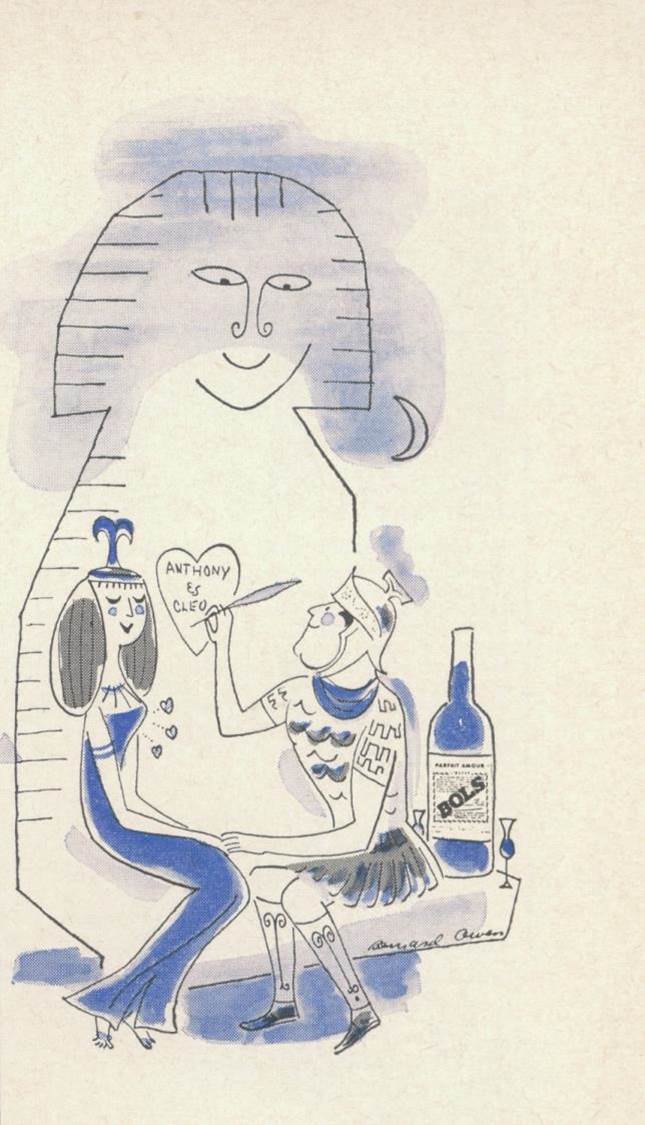
Owen, Bernard,‘Now is the hour’ (detail) for Bols, 1/3 page ad from Gourmet, 1959, ad: 7,5 x 29 cm, complete page 21,2 x 29 cm.
This week we have to talk about love.
Although the name Valentine’s Day indicates an early Christian origin (Saint Valentius ending up in death row for marrying Roman soldiers with Christian spouses. After having healed the daughter of his jailer, his last letter to her was supposed to be signed ‘Your Valentine’), the Romantic sentiments are also projected on antique heroes. Here Roman leader Marc Anthony immortalizes eternal love with the act of carving a heart in the breast of the sphinx for his Egyptian sweety Cleo(patra). Note her reaction: three little hearts resonate back from her bossom. Anthony indeed was succesfull: although Cleopatra was not a Christian, they did marry nevertheless.
While nowadays you stumble across red hearts in shops every where, the Valentine-association already served commercial messages in the 1959s, the year this advert was illustrated for the Dutch brand Bols. It praised a rose petal and orange liqueur, with a hint of vanilla: ‘Parfait d’amour’. This ‘Perfect love’ is a purple colored beverage, though, explaining the used color in the advert.
So wait for the crescent moon, that should be ‘the hour’ to let your heart beat with a passion to equal Cleopatra’s, according to the text: ‘… try it today, you’ll love it!’
See for the origins of the iconography: Grotenhuis, Liesbeth, ‘Lying in the arms…: the origins and reception of Luc Olivier Merson’s ‘The rest on the flight to Egypt’.’ In: Visual Past: A Journal for the Study of Past Visual Cultures. University of Hamburg (Germany)
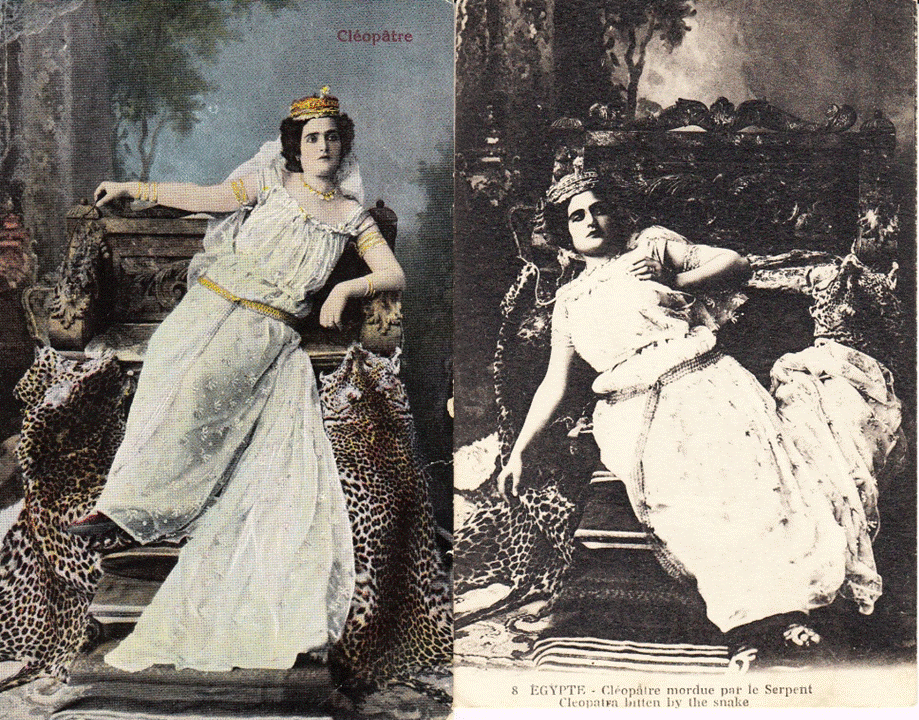
Ephitimios Freres (Port Said), ‘Cléopatre’ ca.1900, photographed and coloured post card, no 97.
Béhar et fils, ‘Cléopatre mordue par le Serpent’ ca.1900, photographed postcard no 8 from the series ‘Egypt’
‘People no longer speak to each other when sitting together in public spaces’, journalist G.R. Simms expresses his concern of the new behavior of his contemporaries: ‘people are writing messages monotonously.’ The medium was, however, not an I-phone or tablet; on the seat beside them were lying ‘little piles of picture postcards.’ In the summer of 1900, writing small messages on post cards with exotic pictures was the latest craze.
Picture postcards became very popular from the 1870s and soon turned into serious collector’s items. Special albums were developed to assemble specific series. The greetings were preferably sent from far destinies, so the relation to tourism soon occurred, Egypt was a beloved place.
Among popular themes from Egypt were portraits of women: ‘authentic locals’ (read: western models or local prostitutes) wearing the veil, but even more alluring was the parade of belly dancers. Photos developed for the tourist market and as an authentic souvenir even specific studios were equipped for staged photography. These two post cards are examples of this phenomenon, be it that the model does not play the contemporain exotic woman, but the historical figure of Cleopatra. We see two different episodes, obviously in a sequence of shots.
The coloured version (probably added by the printer) shows the pharaonic beauty on her lavish throne, be it that she is more oriental dressed and sitting/hanging on panther skins. The landscape behind her is the typical studio prop of a blurry painted screen forming the background.
The black and white photo shows the same personage/ model/ actress a moment later: now she died. The title explains here she is leathally bitten by the snake, depicted with her hand dramatically on her (dressed) breast.
The single photo shoot is clear, yet there are two different publishers claiming the post card. Probably the pictures were available in Port Said, and when the Ephtimios Freres laid hands on the original sepia photo, they decided to print it as a hyper modern, colored souvernir recalling past times.
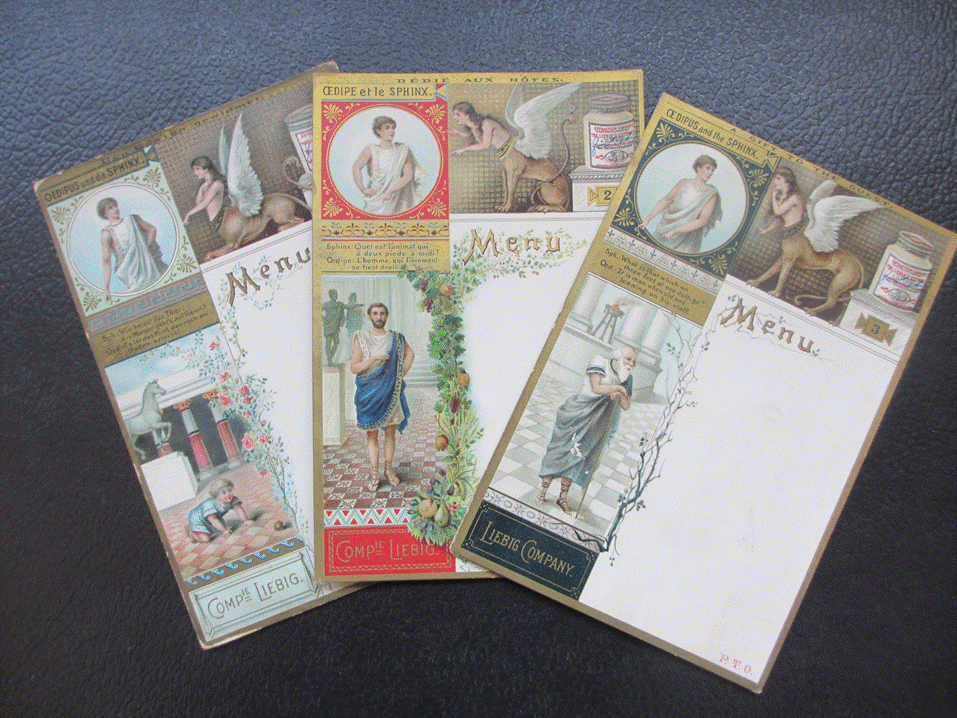
Liebig Publisher’s Antwerp, ‘Oedipus & the Sphinx’ 1897, lithograph, 16,5 x 11 cm. menu card for Liebig Company, Beef Extract M45
Series of three menu cards (A gift to the guest, as stated on top) depicting the three stages in the riddle of the sphinx. On the top right, backed up by the Liebig meat extract, lies, sits and stands the sphinx, communicating with Oedipus in a tondo. He is pointing to the text under him:
Part 1. (German Menu card): Sph: Wie heisst das Thier: am Morgen geht’s auf Vieren? Oed: Es is das Kind, das noch am Boden kriecht!
Part 2. (French Menu card): Sphinx: Quel est l’animal qui a deux peids a midi? Oedipe: L’homme, qui fierement se tient droit.
Part 3. (English Menu card): Sph: What is that which on three feet at eve doth go? Oed: It is man when old and leaning on his staff.’
The text is confirmed by the three stages in manhood, in a Greek interior and different floral branches relating the ages to spring/summer, autumn and winter
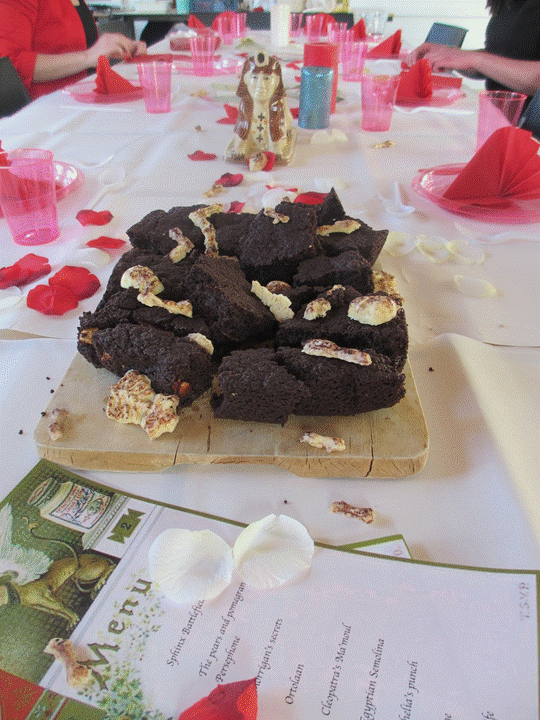
The menus were re-used at the final presentation of my course ‘Babes and Bitches’ were the students cooked a dish based on a female personage from mythology, the bible or history. Here they lay in front of ‘The Sphinx’s battlefield’.
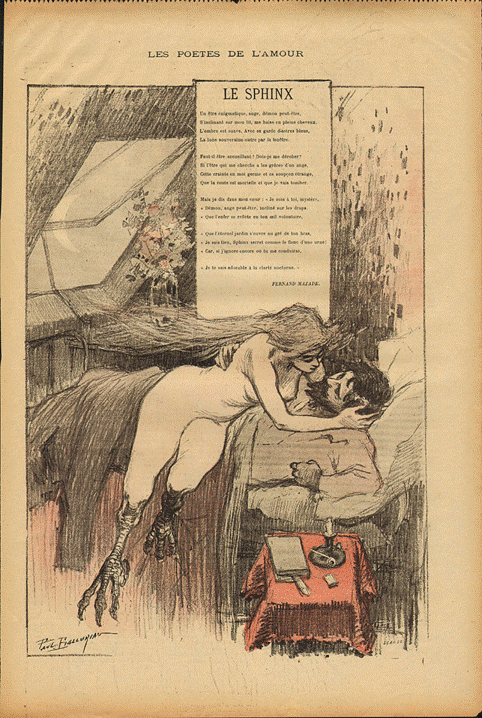
Balluriau, Paul (1860-1917), ‘Le Sphinx’ 1895, two color lithography on news paper, 34 x 23 cm on 40 x 27,5 cm. In: Gil Blas: Illustré Hebdomadaire. Paris 5, no.24 (16 June 1895), p.5.
While Mazade desribes the sphinx in the poem as a seductive, nocturnal creature with angelic features but a demonic character, illustrator Balluriau gives her dangerous talons of a bird, in stead of the charateristic feline claws. As a femme fatale she is fused with her close sister in crime: the Siren.
Illustration of the poem ‘Le Shinx’ by Fernand Mazade (1861-1939):
Le Sphinx
Un être énigmatique, démon peut-être,
S’inclinant sur mon lit, me baise en pleins cheveux.
L’ombre est suave. Avec sa garde d’astres blues,
La lune souveraine entre par la fenêtre.
Faut-il être accueillant? Dois-je me dérober?
Si l’être qui me cherche a les grâces d’un ange,
Cette crainte en moi germe et ce soupçon étrange,
Que la route est mortelle et que je vais tomber.
Mais je dis dans mon couer : ‘Je suis à toi, mystère,
Démon, ange peut-être, incliné sur les draps.
Que l’enfer reflète en ton œil volontaire,
Que l’éternel jardin s’ouvre au gré de ton bras,
Je suis tien, Sphinx secret comme le flanc d’une urne!
Car, si j’ignore encore où tu me conduiras,
Je te sais adorable à la clarté nocturne.’
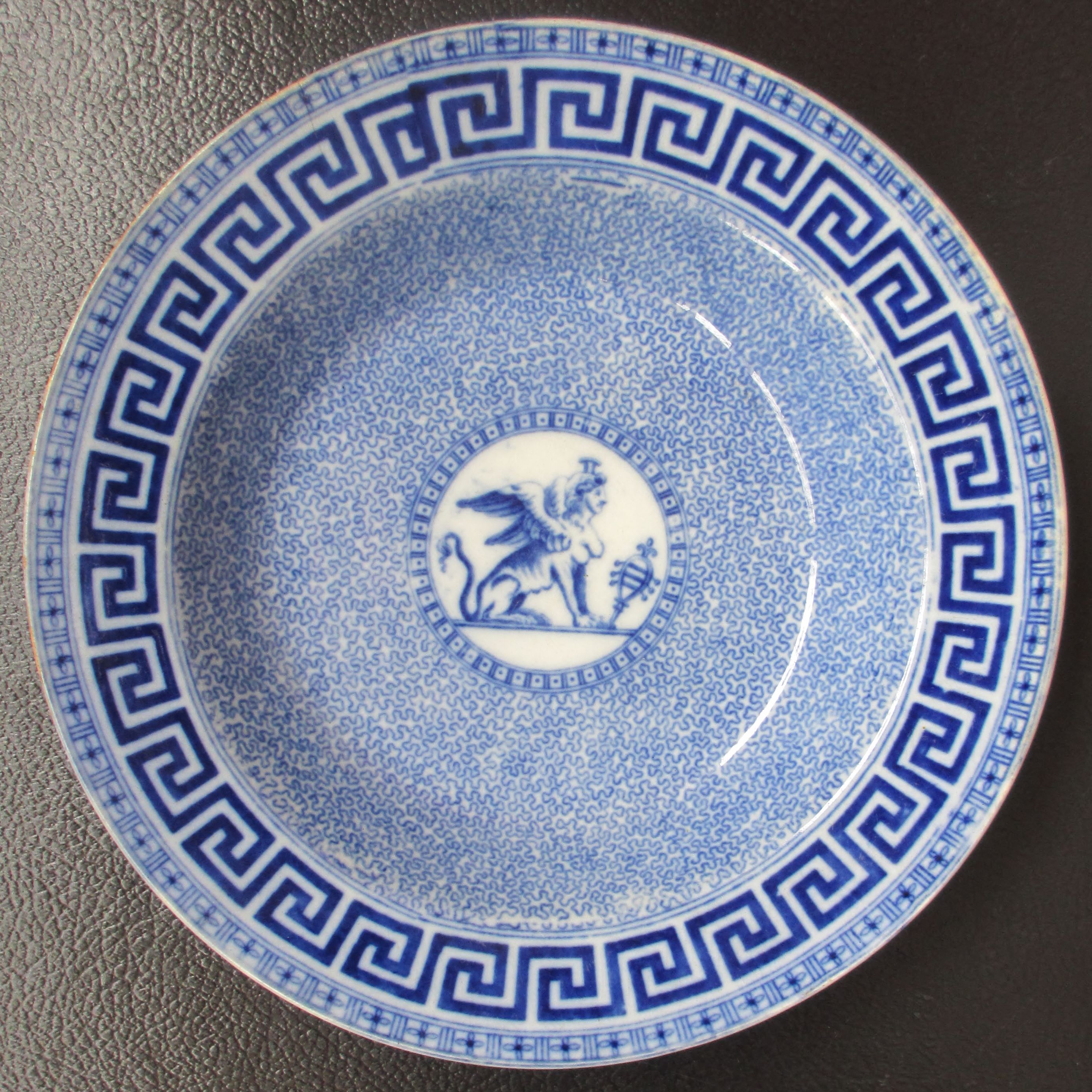
Related to the recently published catalogue on ceramic by the Friends of the Museum of Ceramics, de Prinsessehof (see Books/catalogues). (Not to mention blue Monday tomorrow: might this variant cheer you up!)
A porcelain platter designed with a ‘Greekianesque’ motif of a meandering border (a stencil was used, but not a 100% fitting one as shows the upper left corner where it does not go in a row.
The center piece is a sphinx, Greek in its sitting posture and the upright wings, Egyptian in its head dress (reminding of the crown of the goddess Nephtys) and holding the holy rattle, the sistrum. The addition of the fleur the lis on top if it indicates the European design, as are the female breasts.
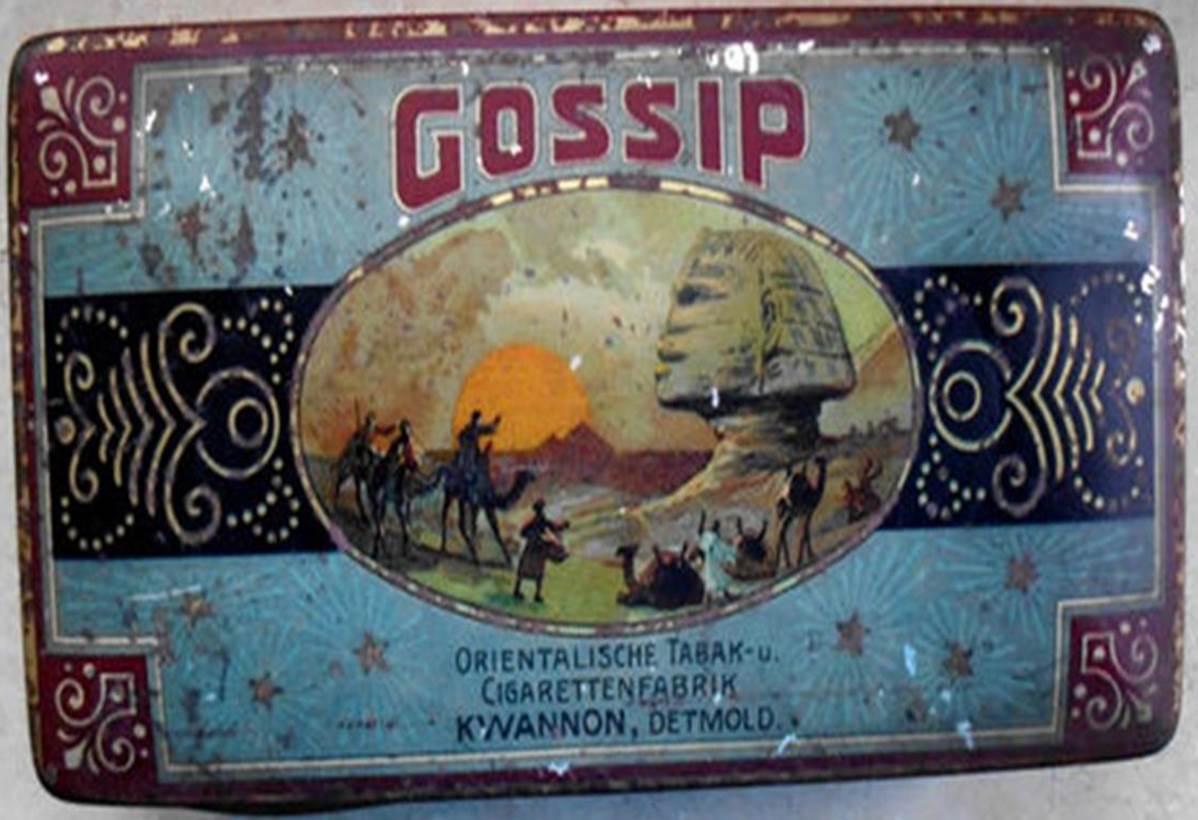
Orientalische Tabak und Cigarettenfabrik Kwannon (S.F.W. Brueggemeyer cigarets), ‘Gossip’, from 1897, lithographed tin box containing about 50 cigarets, ca. 13,5 x 7,5 x 3 cm. Detmold (Germany). CA
Egyptian Tobacco was especially popular in Germany. Here also tin boxes were manifactured, decorated to show the appealing land of origin.
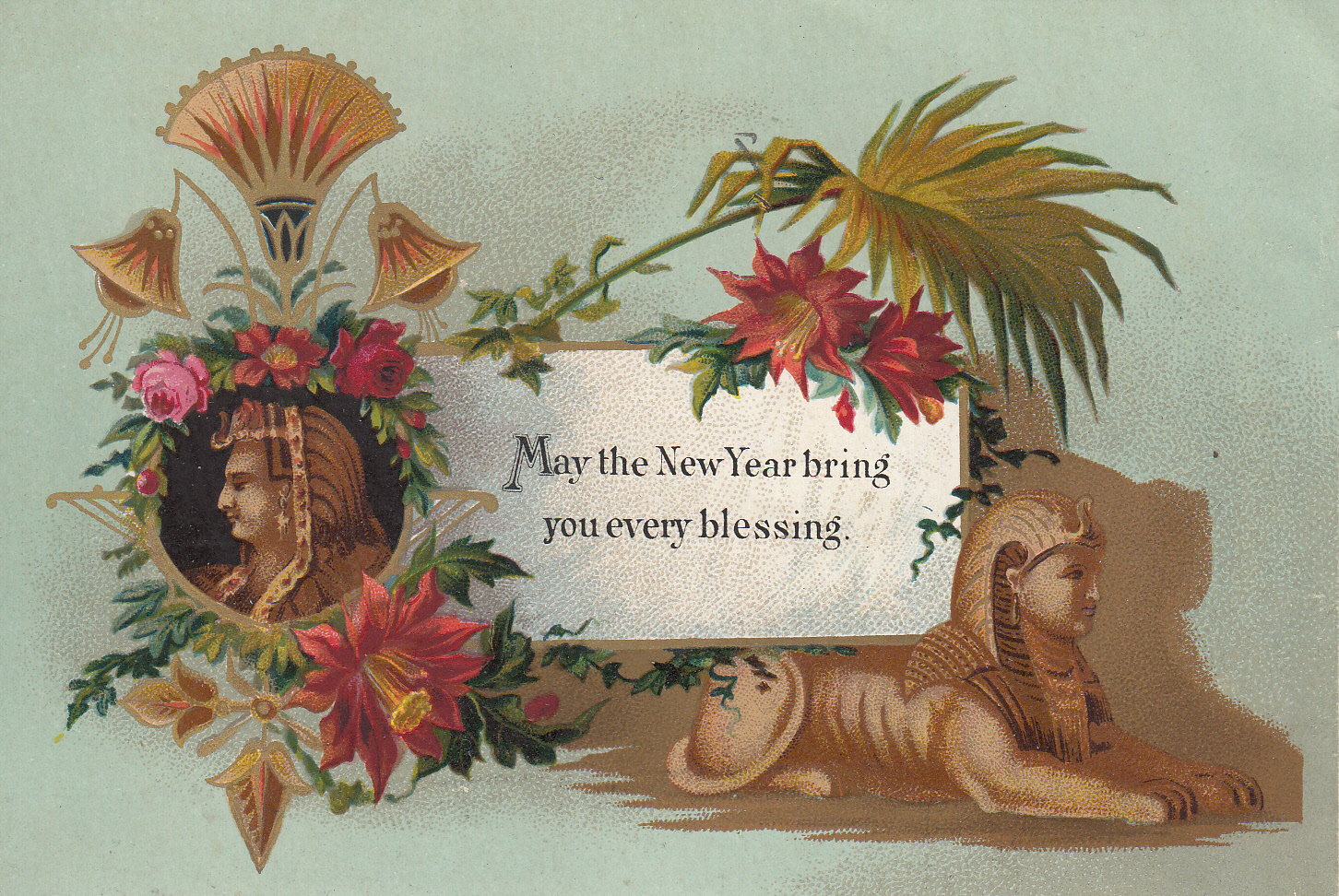
Victorian greeting card, 1879, lithograph
On this website I also start a blog on my remarkable finds, related to my research, the Sphinx. Although I focus on (late) nineteenth century painting, popular culture is also a very interesting source. In its parallel development, the iconography of fine art was often used as a starting point. Yet, not being bound to the strict demands of painting, the artists could experiment, resulting in freer and therefore more experimental compositions.
Here we see a fine lithographed card communicating new year wishes. The back is blank, which indicates it is a pre-postcard: it was not mailed, but handed over in an enveloppe.
And you are invited to react….